How low can demand for cereals go?
The following article has been written for and published by Farmers Guide. It is protected by copyright and may not be reproduced in part or whole without the written express permission of both Openfield and Farmers Guide.
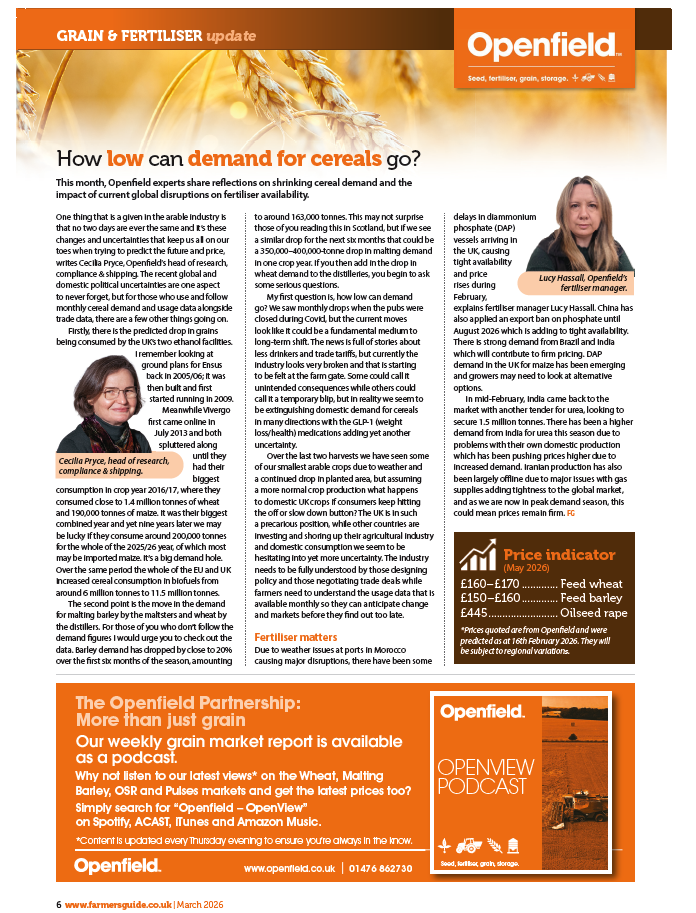
Openfield experts share reflections on shrinking cereal demand and the impact of current global disruptions on fertiliser availability.
One thing that is given in the arable industry is that no two days are ever the same and its these changes and uncertainties that keep us all on our toes when trying to predict the future and price. The recent global and domestic political uncertainties are one aspect to never forget but for those who use and follow monthly cereal demand and usage data alongside trade data there are a few other things going on. Firstly, there is the predicted drop in grains being consumed by the UK’s two ethanol facilities. I remember looking at ground plans for Ensus back in 2005/06, it was then built and first started running on 2009. Meanwhile Vivergo first came online in July 2013 and both spluttered along until they had their biggest consumption in crop year 2016/17, where they consumed close to 1.4 million tonnes of wheat and 190,000 tonnes of maize. It was their biggest combined year and yet nine years later we may be lucky if they consume around 200,000 tonnes for the whole of the 2025/26 year, of which most may be imported maize. It’s a big demand hole. Over the same period the whole of the EU and UK increased cereal consumption in biofuels from around 6 million tonnes to 11.5 million tonnes.
The second point is the move in the demand for malting barley by the Maltsters and wheat by the Distillers. For those of you who don’t follow the demand figures I would urge you to check out the data. Barley demand has dropped by close to 20% over the first six months of the season, amounting to around 163,000 tonnes. This may not surprise those of you reading this in Scotland, but if we see a similar drop for the next six months that could be a 350,000 to 400,000 tonnes drop in malting demand in one crop year. If you then add in the drop in wheat demand to the distilleries, you begin to ask some serious questions.
My first question is how low can demand go? We saw monthly drops when the pubs were closed during Covid, but the current moves look like it could be a fundamental medium to long term shift. The news is full of stories about less drinkers and trade tariffs, but currently the industry looks very broken and that is starting to be felt at the farm gate. Some could call it unintended consequences while others could call it a temporary blip, but in reality we seem to be extinguishing domestic demand for cereals in many directions with the GLP-1 (weight loss/health) medications adding yet another uncertainty.
Over the last two harvests we have seen some of our smallest arable crops due to weather and a continued drop in planted area, but assuming a more normal crop production what happens to domestic UK crops if consumers keep hitting the off or slow down button? The UK is in such a precarious position, while other countries are investing and shoring up their agricultural industry and domestic consumption we seem to be hesitating into yet more uncertainty. The industry needs to be fully understood by those designing policy and those negotiating trade deals while farmers need to understand the usage data that is available monthly so they can anticipate change and markets before they find out too late.
Fertiliser matters
Due to weather issues at ports in Morocco causing major disruptions, there have been some delays in Diammonium Phosphate (DAP) vessels arriving to the UK, causing tight availability and price rises during February. China have also applied an export ban on phosphate until August 2026 which is adding to tight availability. There is strong demand from Brazil and India which will contribute to firm pricing. DAP demand in the UK for Maize has been emerging and growers may need to look at alternative options.
Mid-February India came back to the market with another tender for urea, looking to secure 1.5 million tonnes. There has been a higher demand from India for urea this season due to problems with their own domestic production which has been pushing prices higher due to increased demand. Iranian production has also been largely offline due to major issues with gas supplies adding tightness to the global market, and as we are now in peak demand season this could mean prices remain firm.