Could SFI cash be a false economy?
The following article has been written for and published by Farmers Guide. It is protected by copyright and may not be reproduced in part or whole without the written express permission of both Openfield and Farmers Guide.
‘Several years into SFI, what are farmers really thinking about it?’ asks Openfield’s head of research, compliance and shipping, Cecilia Pryce
After several years into SFI, I wonder what you’re all really thinking about it. After the harvest we have had and the summer of lack of rain post June, matched with fires and tinder dry conditions, is it not time to step back and ask if all the schemes are working as anticipated? How many of you are questioning your SFI actions last year and wondering if any of them affected your yields or was the yield purely a function of water? I have heard so many differing views around issues with cover crops, with not applying inputs leading to disease and infestation and that’s before we discuss the amount of thistle seeds flying around the countryside. Fortunately, the quality of most of the grain that we have seen seems to be relatively good, although as we all know if all grain is great quality, it erodes the milling premium, with the current levels almost an insult to growers. But if it had been a more standard ‘weather’ year how many of you would really have reached your anticipated or 5-year average yields, and if the harvest hadn’t been so dry what sort of quality would we be facing, would the protein levels be anywhere near what they are?
Would the milling premiums be so low? Would your untreated farm saved seed performed or would disease have played a large part in yield erosion? It’s tough but with inputs being so expensive relative to grain prices what does your plan for next year look like and does the SFI cash and restricting inputs really help or do they start to hinder yield and become a false economy? At the time of writing, there is little confidence in the size of the UK’s 26/27 wheat crop, will we be lucky to have a marginally bigger crop than 25/26? One thing for certain is that we will need imports of wheat. Milling tonnes may drop, due to enough availability and the functionality of the UK crop but domestic demand will exceed supply especially with such a dry summer and the demand for livestock feed. This need for feed and yet another small harvest should be a wake-up call for Government to take a serious look at all the schemes on farm and work out how much arable land we as a country need to be productive.
They could also look at the fact that the EU 27 will be short of around 20M/mt of cereals year on year also due to weather, while Russia remains the world’s largest wheat exporter. I don’t believe the UK arable industry needs funds to increase innovation and efficiency; it just needs land being used to grow crops by farmers who can afford to do so – call it an investment into the long-term sustainability of UK Agriculture without SFI. Most farmers know how to farm in a sustainable way. Much has changed from the days of ripping out hedges and spraying anything that moved. It’s important for everyone to realise that inputs have a purpose in life, it would be very difficult to achieve clean crops which comply with legislative maximum residue levels and toxins without using chemistry and inputs. It’s also very difficult to guarantee a reasonable yield without giving crops the best inputs possible. Yes, weather is a vital component but if we carry on the way we are before long the investment needed to keep UK agriculture alive will get bigger and we will be back to the Agricultural policies of the early 90’s or worse still ‘dig for victory’.
Fertiliser matters
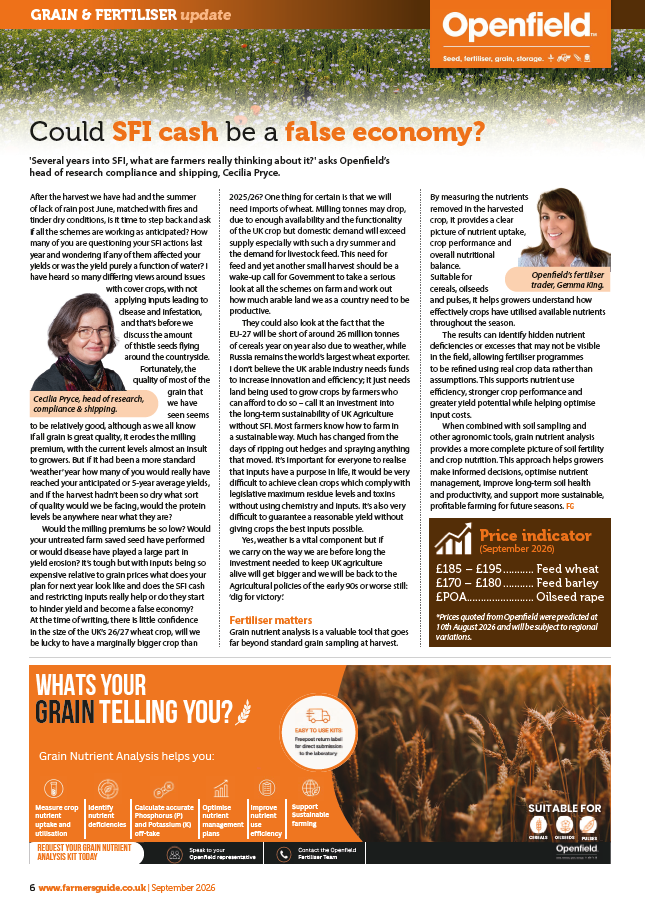
Grain nutrient analysis is a valuable tool that goes far beyond standard grain sampling at harvest. By measuring the nutrients removed in the harvested crop, it provides a clear picture of nutrient uptake, crop performance and overall nutritional balance. Suitable for cereals, oilseeds and pulses, it helps growers understand how effectively crops have utilised available nutrients throughout the season.
The results can identify hidden nutrient deficiencies or excesses that may not be visible in the field, allowing fertiliser programmes to be refined using real crop data rather than assumptions. This supports nutrient use efficiency, stronger crop performance and greater yield potential while helping optimise input costs.
When combined with soil sampling and other agronomic tools, grain nutrient analysis provides a more complete picture of soil fertility and crop nutrition. This approach helps growers make informed decisions, optimise nutrient management, improve long-term soil health and productivity, and support more sustainable, profitable farming for future seasons.